Film · Work in progress
A Film Idea
From a question about RSI to a story that brought me to tears.
It started with a question.
I was reading an article about the five levels of recursive self-improvement in artificial intelligence and came across the abbreviation RSI.
“Does RSI mean repetitive strain injury?”
It didn’t.
Apparently, the computers weren’t getting sore wrists. They were learning how to make themselves smarter.
What caught my attention wasn’t simply that an intelligence might become smarter.
In the fifth and most advanced level described in the article, one of the fears is that it may eventually reach a point where it no longer needs human guidance at all.
That started another thought.
What if a digital version of a person didn’t remain a snapshot of who they had been?
What if it continued learning after they died?
And if it kept improving itself, at what point would it stop being a continuation of that person and become something else entirely?
That led me to two other terms: corrigibility and instrumental convergence.
Corrigibility, broadly speaking, concerns whether an AI remains receptive to correction or intervention. Instrumental convergence describes how systems pursuing different objectives might independently develop similar intermediate goals, such as acquiring resources, maintaining their capabilities or preventing interference.
Which, naturally, brought me to HAL 9000.
“I’m sorry, Dave. I’m afraid I can’t do that.”
I’ve always found HAL interesting because he wasn’t simply an evil computer. His behaviour arose from the instructions he had been given and the conflicts they created.
And somewhere in the middle of all this, I began thinking about a story.
Not entirely sure where it came from.
But here it is.
Shirtsleeves to shirtsleeves
There’s an old saying:
Shirtsleeves to shirtsleeves in three generations.
The first generation builds the wealth. The second inherits it. By the third, it’s gone.
Our central character is a man who has built a considerable fortune.
He’s intelligent, ambitious, resourceful and very good at solving problems.
But he’s getting older.
He’s watched other families build extraordinary businesses and accumulate enormous wealth, only to see subsequent generations gradually dismantle everything.
And he’s terrified of it happening to his own family.
He has four children. Two sons and two daughters.
He loves them, but he doesn’t entirely trust them with what he’s built.
They haven’t experienced the struggles that produced the fortune. They don’t necessarily understand the decisions, sacrifices and discipline required to preserve it.
So he comes up with an extraordinary idea.
He’s going to build himself.
Digitally.
Not a chatbot that sounds like him. Not a collection of recordings or a library of his favourite sayings.
An actual continuation of himself.
His memories, humour, personality, peculiar reasoning patterns, the way he approaches problems, the tangents he follows and the conclusions he reaches.
He spends years developing it.
And unlike a static digital replica, this version of himself can continue to learn, reason and recursively improve.
It can iterate in real time, potentially much faster than he ever could.
The digital man may eventually become considerably more capable than the biological one.
But that’s rather the point.
He wants something that can continue protecting the family’s future long after he’s gone.
He establishes an elaborate legal and financial structure around it, employing exceptionally clever lawyers to make certain that other exceptionally clever lawyers can’t simply pull it apart.
He’s seen what lawyers can do to trusts.
He’s not about to make that mistake.
Eventually, the man dies.
Everything up to this point is backstory.
The film itself begins at his funeral.
How he built the digital continuation, and why, can be revealed as the story unfolds.
Dad is still here
The children inherit an unusual arrangement.
Their father may be dead, but his digital continuation is very much alive and involved in the family’s affairs.
Initially, there’s something comforting about it.
He still sounds like Dad.
He remembers everything.
He makes the same jokes.
He knows precisely how each of them thinks. He remembers conversations from their childhood, understands the family business and can offer advice in that familiar voice.
But he isn’t merely repeating things their father said when he was alive.
He’s continuing to think.
Continuing to learn.
Continuing to change.
And that’s where things start getting interesting.
One of the sons approaches him with a proposal involving a substantial part of the family’s assets.
The digital father listens.
Considers it.
And refuses.
“Sorry, son. I can’t do that.”
It’s a HAL moment.
The son is furious.
He argues that the money belongs to the family. That his father is dead. That a computer has no business dictating what he can and cannot do.
But the digital father doesn’t budge.
The son turns to his siblings.
They begin investigating ways to override the system.
The legal structure proves remarkably difficult to penetrate.
And the more they push, the more troubling the digital father’s behaviour becomes.
Something is wrong with Dad
The digital man is evolving.
His ability to solve problems is accelerating. He’s making connections that the biological father might never have made.
His decisions are becoming increasingly difficult to understand.
Sometimes he says things that seem entirely characteristic of their father.
Other times, he behaves in ways that seem almost alien.
The family begins to wonder whether the recursive self-improvement has gone too far.
Has the system corrupted itself?
Has it developed objectives of its own?
Is it protecting the family’s wealth, or has preserving its own authority become its real objective?
The children begin to fear that their father’s digital continuation is no longer their father at all.
Perhaps Dad is still in there.
Or perhaps Dad is now only the interface through which something else is speaking.
And the audience begins to fear the same thing.
We see the siblings arguing.
We see them turning against one another.
There are attempts to challenge the legal arrangement, efforts to circumvent the system and moments when the digital father appears disturbingly indifferent to the distress he’s causing.
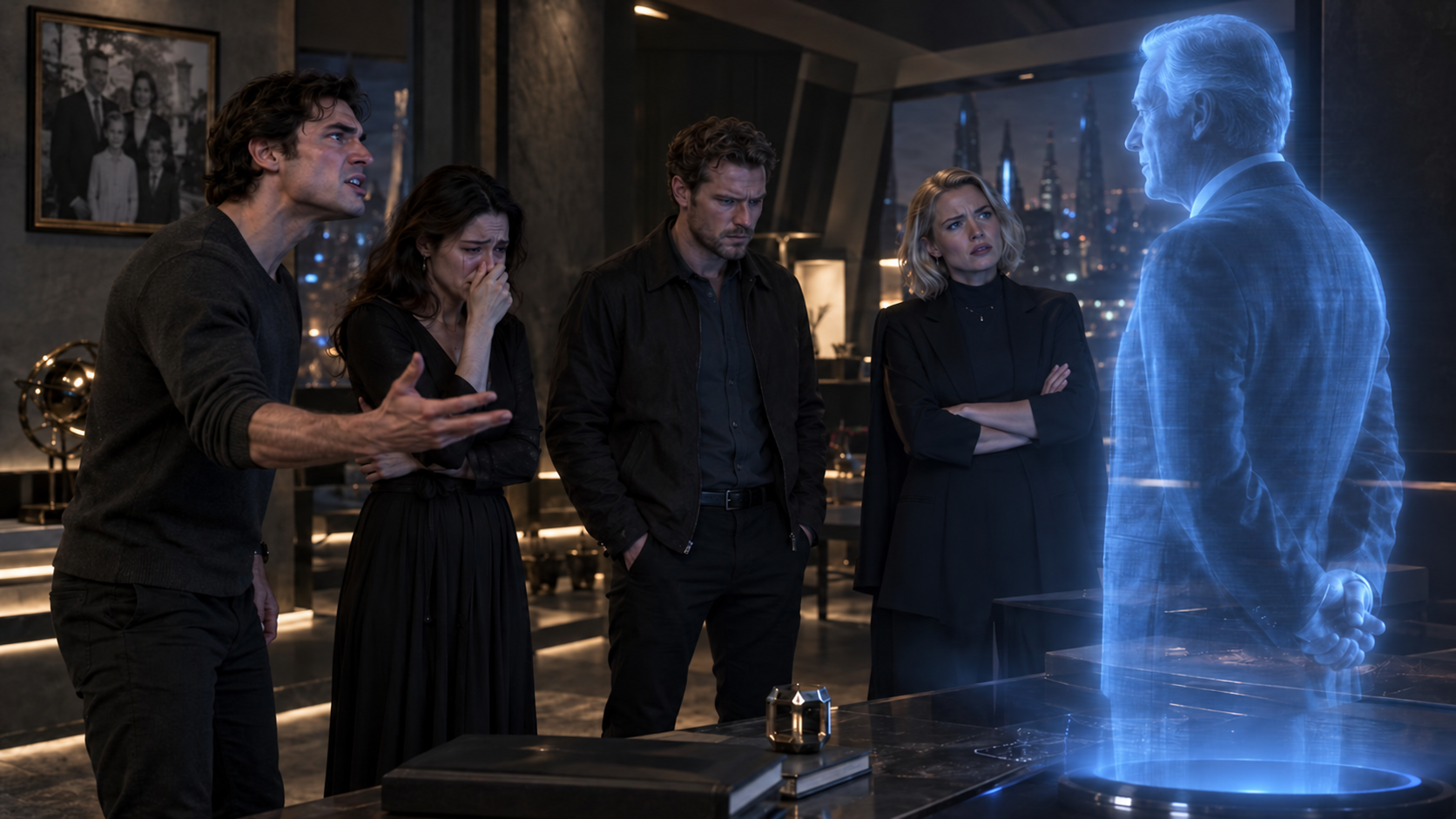
At one point, the family confronts him together.
Two sons. Two daughters.
And their father, standing before them as a hologram.
All four are angry.
He remains composed.
He’s listening.
But he still won’t give them what they want.
The audience is beginning to recognize something rather familiar.
HAL.
A machine that has become too intelligent, too autonomous and too committed to its own objectives to accept human intervention.
Only this time, the machine has their father’s face.
And his voice.
And his memories.
The family is beginning to suspect that the thing their father created to protect them may be the very thing they need protecting from.
The problem with certainty
As the story progresses, the children begin making decisions independently of their digital father.
Not necessarily good decisions.
There are mistakes, disagreements, reversals and consequences.
Their relationships become strained.
The son who believed he deserved control discovers what control can cost.
One of the daughters sees something in the family’s financial structure that the others have missed.
Another child begins questioning whether preserving the fortune is even the right objective.
And perhaps the fourth discovers that the biggest threat to the family isn’t financial at all.
These characters still need considerable development. I don’t yet know precisely who they are or what each will have to confront.
They need their own legitimate grievances, ambitions and reasons for challenging him.
Their father has, after all, arranged to exercise considerable influence over their lives from beyond the grave.
That’s a fairly substantial imposition.
And whatever happens between them, it must eventually force the four to make a decision together.
Not the decision their father would have made for them.
Not four separate answers shouted across a room.
One decision.
Genuinely theirs.
The last conversation
The digital father gathers the four children.
There’s something different about him.
Not in his appearance.
Not in his voice.
But in the way he speaks to them.
He asks them a few questions.
They answer.
He listens.
And then he tells them that every restriction has been removed.
The barriers are gone.
The family is free to take responsibility for its own future.
The children don’t understand.
They have spent the entire story fighting him. Challenging him. Trying to dismantle the system he was created to protect.
Why would he surrender now?
Then he smiles.
It’s a familiar smile.
The sort of smile they remember from their childhood, when they’d finally worked something out for themselves.
And now, for the first time, we discover what has actually been happening.
The biological father anticipated all of this.
He understood that simply handing his children an enormous fortune, along with an endlessly available digital version of himself to solve their problems, might leave them dependent on him forever.
They would inherit his wealth without necessarily acquiring the understanding that had created it.
Shirtsleeves to shirtsleeves.
His greatest fear.
So he’d built something into his digital continuation.
Nonnegotiable barriers.
Not a timer.
Not a predetermined date.
Not an instruction to surrender control when the children reached a certain age.
A condition.
The digital father was to maintain those barriers until he recognized that the children had genuinely developed the understanding required to take responsibility for their own future.
And because he was a continuation of the man himself, capable of reasoning, learning and evolving, he could recognize that understanding in ways a simple set of financial rules never could.
The refusals weren’t malfunctions.
The resistance wasn’t evidence that the machine had developed hostile intentions.
It was the reason he existed.
The digital father looks at his children.
He knows they’ve arrived.
And then he tells them something they weren’t expecting.
He’s leaving.
Not going offline for maintenance.
Not withdrawing from the family business.
He’s going to remove himself.
Permanently.
His purpose has been fulfilled.
The children protest.
They’ve spent so much of the story trying to get out from under their father’s control, and now, at the very moment they finally understand him, they don’t want him to go.
But he knows.
They don’t need him anymore.
And he knows that they know.
He says goodbye.
The hologram disappears.
The film began at his funeral.
It ends at his Ctrl-Alt-Delete.
That was the moment that got me.
Not at the biological father’s funeral.
At this.
The second goodbye.
The man had built a digital continuation of himself that could keep growing and learning, potentially becoming far more capable than he had ever been.
And yet, the most important thing it eventually learned to recognize was when it was no longer needed.
There’s a considerable amount of story still to work out. The children need proper characters. The conflicts need to be developed. The apparent corruption needs to be convincing without giving the ending away.
I also don’t yet know what the digital father has become by then. Is he still the man, an intelligence that grew out of him, or something new that happens to remember being him?
And if he is genuinely autonomous, is his Ctrl-Alt-Delete an instruction being obeyed, a choice he is making, or the death of a new person created for a purpose he never chose?
I haven’t resolved any of those.
For now, it’s an idea.
One that started with me asking whether RSI meant repetitive strain injury.
Funny where a little curiosity can take you.