Reflections
Remember Lassie?
If you’re of a certain age, you probably remember Lassie.
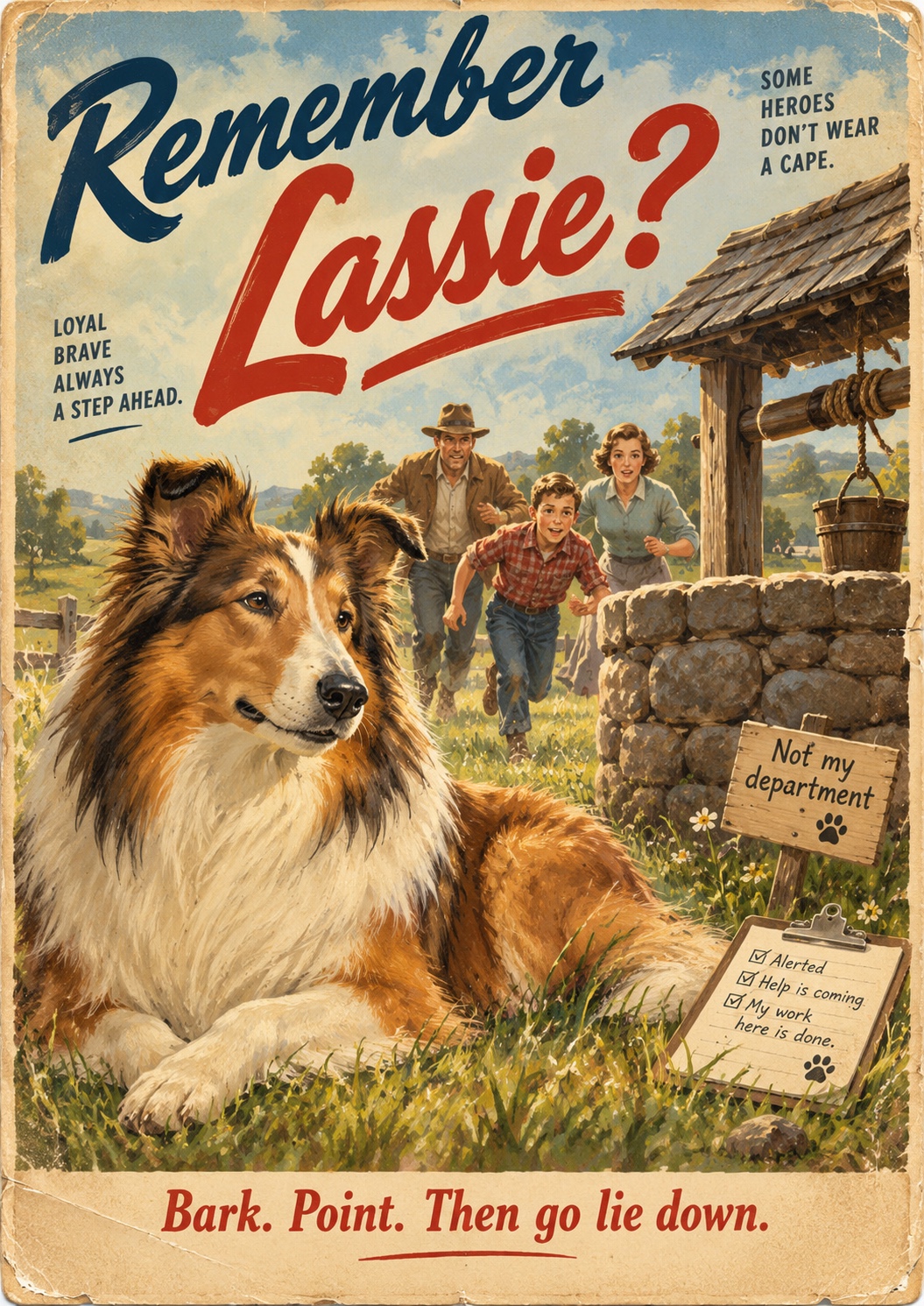
The basic premise was wonderfully simple. Lassie was a collie who had an uncanny ability to know when somebody was in trouble. A child was lost, someone was injured, there was danger somewhere, and Lassie would race off to find help.
The joke that grew out of the show was always some version of:
What is it, Lassie? Timmy fell down the well?
Lassie would bark, somebody would understand, and the rescue would begin.
She was very good at identifying the problem.
Importantly, she did not then deliver a forty-minute presentation explaining exactly how everyone should solve it.
I’m beginning to appreciate the distinction.
I have a tendency, particularly with people I care about, to see something and keep going.
I notice a pattern.
Then I explain the pattern.
Then I explain why I think the pattern exists.
Then, because my little brain has already wandered three junctions further down the road, I anticipate the objection and explain that too.
And if the person still hasn’t arrived at the conclusion I have reached, there is always the temptation to have another go.
The intention is usually good.
I am trying to help.
But somewhere along the way, encouragement can quietly turn into persuasion.
Sometimes somebody I care about is facing a problem, a change, or simply a period where they don’t quite know what comes next.
I may see possibilities that they don’t.
Or at least I think I do.
The temptation is to help them see those possibilities too.
So I offer an observation.
Maybe suggest they stay open.
Maybe encourage a little soul searching.
Maybe point toward something they appear to be dismissing too quickly.
All perfectly reasonable.
The difficult bit is knowing when to stop.
Because there is a meaningful difference between:
Have you thought about this?
and:
Let me explain why you really should think about this.
The first is an invitation.
The second is beginning to sound suspiciously like a case for the prosecution.
And if you are someone who enjoys thinking things through, it can be very tempting to keep going.
One thought leads to another.
A clarification becomes a longer discussion.
A longer discussion becomes an attempt to get the other person to see things your way.
Before long, what started as encouragement has quietly become persuasion.
And persuasion, given enough enthusiasm and intellectual stamina, can become something resembling counselling by intellectual waterboarding.
That is the bit I’m learning to recognize.
Because seeing something does not make me responsible for making another person see it.
Caring about somebody does not mean I have to get them to my conclusion.
Sometimes the useful thing is simply to put an idea into the room.
Then leave it there.
If there is something worthwhile in it, they can pick it up themselves.
They might think about it later that evening.
They might reject it.
They might come back to it six months from now.
They might eventually announce exactly the same idea as something they have independently discovered, at which point the correct response is obviously:
Brilliant idea.
Not:
YES, THAT IS WHAT I HAVE BEEN SAYING FOR SIX MONTHS.
Growth has limits.
I’m also starting to realise that this is not about thinking less.
I like my little brain.
I like that it wanders.
I like that it sees connections.
I like pulling ideas apart and putting them back together.
The problem was never really the thinking.
It was assuming that every useful thought needed to be exported.
Sometimes the thought can simply stay with me.
Sometimes I can say the thing once.
Maybe twice.
Then trust the other person to do whatever they want with it.
That is not indifference.
It might actually be a better form of respect.
You are saying:
I care enough to tell you what I see.
But also:
I respect you enough to leave the rest to you.
Which brings me back to Lassie.
She noticed something was wrong.
She barked.
She pointed everybody toward the well.
Then the humans took over.
Lassie did not climb down the well, rescue Timmy, provide counselling about why he had fallen into the well, and develop a comprehensive well-avoidance strategy for the remainder of his childhood.
She knew her role.
I’m working on mine.
Bark.
Point.