Training · Identity · Reflection
I Train to Remember Who I Am
This piece has taken me more than a year to write, although for most of that time I was not actually writing it.
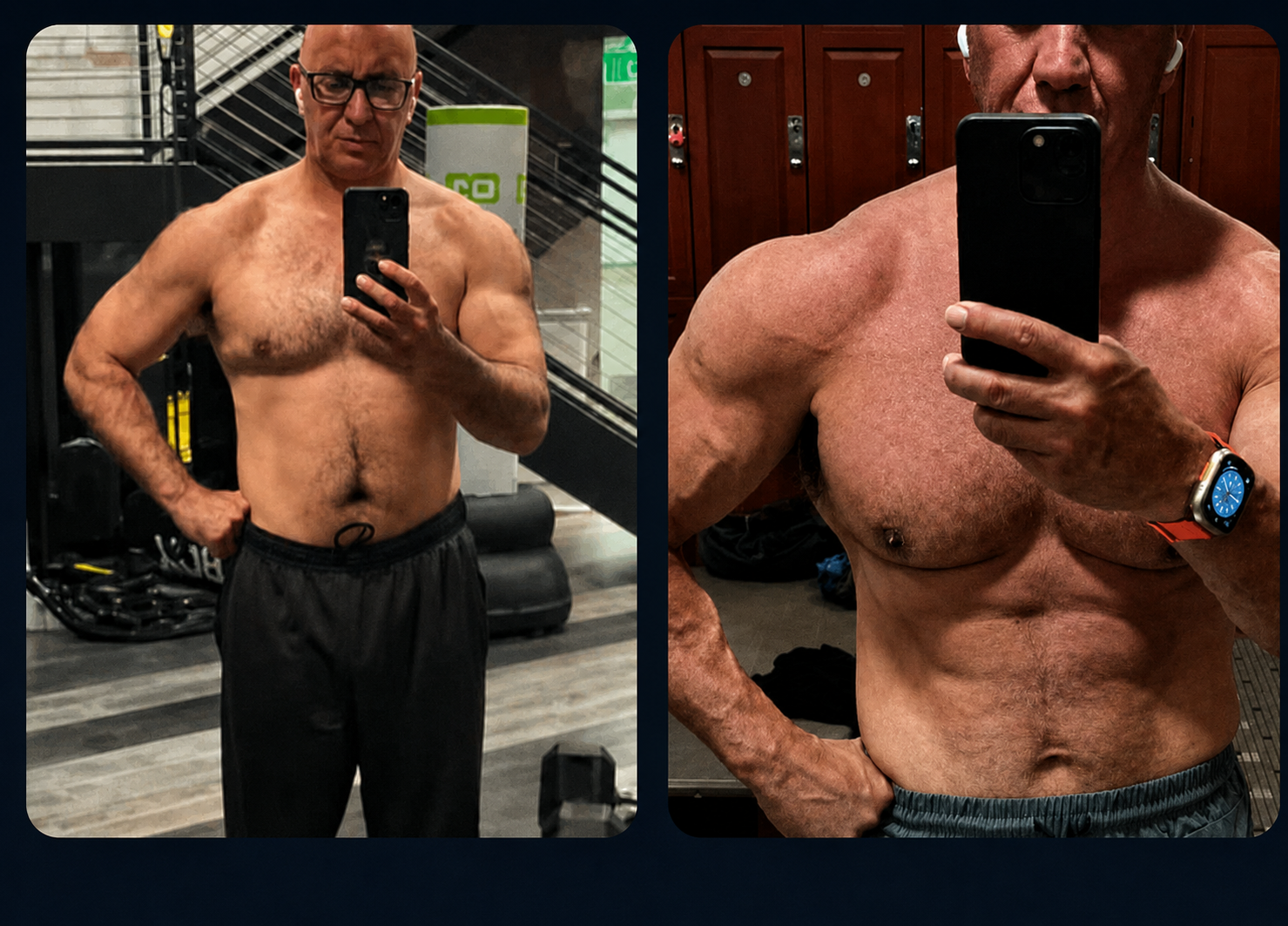
I was thinking about it.
Turning it over.
Training through it.
Occasionally discovering that something I had confidently decided it meant was not quite the whole thing.
It began, as many profound philosophical insights do, with an idea for a T-shirt.
I was thinking about weights and working out, as I often do, and I arrived at a sentence:
I train to remember who I am—not to prove it.
I liked it immediately.
I played with how it might work on a T-shirt and tried a few variations, attempting to improve it, but eventually decided that the OG was still the best.
It had a satisfying weight to it.
It looked good written down.
It would probably look even better stretched heroically across my chest while I wandered through the gym carrying a shaker bottle.
But although the sentence felt true, I was not entirely sure why.
That has taken longer.
Over the following year, I kept returning to it.
Sometimes during training.
Sometimes while thinking about training.
Sometimes after a session in which my behaviour had not been nearly as spiritually developed as the T-shirt might have suggested.
Because the honest truth is that I do sometimes train to prove something.
Sometimes I want to prove that I can still lift a particular weight.
Sometimes I want to improve what I see in the mirror.
Sometimes I compare myself with another person, an earlier version of myself, or some imaginary standard I have quietly decided must be satisfied before the universe will issue my certificate.
Sometimes I want the number.
Sometimes I want the recognition.
Sometimes I lifted less the previous week and have taken this as a personal insult.
It would be dishonest to pretend those things never enter the room.
They do.
So the sentence is not a declaration of perfectly purified motives.
It is more like a correction.
A place to return when training begins to slide from practice into performance.
The more I thought about it, the more interested I became in the word remember.
What exactly am I supposed to be remembering?
It is tempting to make this sound grand.
Some essential warrior self.
A man of discipline and iron.
A heroic identity waiting beneath the ordinary layers of life for somebody to load another plate onto the bar.
But I do not think that is quite it.
What I remember through training is usually much more practical.
I remember patience.
I remember concentration.
I remember humility.
I remember that I can feel reluctant to do something and still begin.
I remember that doing difficult things does not always require a dramatic surge of motivation. Sometimes it requires changing my clothes, getting into the car and starting the warm-up.
I remember how to stay with something when it becomes uncomfortable.
I remember that strength is not only expressed through force. It is also expressed through restraint, attention and the willingness to repeat something until it is done properly.
I remember to take care of my body.
That may sound like a strange thing to say about placing hundreds of pounds on a bar and attempting to move it.
But kindness towards the body is not always soft.
Sometimes it means asking something difficult of it.
It also means feeding it, allowing it to recover, paying attention to pain, sleeping properly and resisting the urge to punish it for not performing exactly as expected.
The body keeps excellent accounts.
Eventually it sends an invoice.
Training has taught me that looking after myself and challenging myself are not opposing ideas.
Done properly, each makes the other possible.
The same is true of humility.
A heavy barbell has very little interest in the story I have been telling myself.
It does not care what I lifted last year.
It does not care how strong I believe I should be.
It does not care that the warm-up felt unusually good or that I had already mentally composed the triumphant account of the session.
The weight is simply there.
Some days it moves.
Some days it moves badly.
Some days it appears to have formed a small committee and decided not to cooperate at all.
That honesty can be useful.
Not because the iron contains some mystical truth unavailable elsewhere, but because the feedback is immediate.
Either I maintained my position or I did not.
Either I stayed patient or I rushed.
Either I remained focused or my attention wandered.
Either I respected what my body was telling me or I allowed ego to translate every warning into cowardice.
There is always more information available if I am willing to receive it.
Over time, this connected with another idea in my training:
Make extraordinary weights look ordinary.
I have become less interested in the largest weight I can lift once and more interested in the strength I can reliably inhabit.
A single lift can prove that something happened.
It can prove that, on one particular day, under one particular set of conditions, I was capable of moving a particular weight.
That matters.
I like those moments.
But repeatability tells me something different.
Returning to the work, maintaining form, raising the floor and making strength available on an otherwise ordinary day begins to turn it into part of who I am.
Proving looks for the exceptional moment.
Remembering is built through repetition.
This has become more important as I have grown older.
I remember my father remaining active well beyond the age when many people begin surrendering parts of themselves. He played competitive football into his sixties and was still driving at ninety.
That stays with me.
There is one thing to live until eighty.
There is another thing to remain able to enjoy your life until eighty.
I am not training because I believe ageing can be defeated by sufficient effort and a well-organised supplement drawer.
Age will arbitrate eventually.
But I would like to remain in the conversation.
I want strength, movement and physical confidence to remain available to me for as long as possible.
Not because I am trying to preserve a younger version of myself in glass.
Because I want to retain access to the life I still recognise as mine.
The ability to move.
To work.
To play music.
To dance.
To travel.
To carry something heavy without needing to convene an emergency meeting.
To remain useful.
To remain involved.
Perhaps that is another meaning of remembering who I am.
Not clinging to who I was, but continuing to practise the qualities I hope will remain with me.
There are ways of pursuing improvement that begin to resemble trying to replace yourself.
Become more impressive.
More controlled.
More dignified.
More acceptable.
Remove the awkward parts.
Correct the undisciplined parts.
Construct somebody better and present them to the world as evidence that the project succeeded.
I have lived enough life to be wary of that.
Growth should not require the assassination of every earlier version of yourself.
Some things need to change.
Some things need to heal.
Some things need to be left behind entirely.
But perhaps the purpose is not to manufacture a different person.
Perhaps it is to become more capable of returning to the person you recognise when the noise, performance and self-protection fall away.
That is why the sentence has stayed with me.
It is not a description of a state I have permanently achieved.
It is not a claim that ego no longer trains with me.
It is not proof that I have transcended comparison, vanity or the occasional desire to do something impressive in front of people who may not even be watching.
It is aspirational.
A direction of travel.
A reminder that the deepest value of training may not be what it allows me to demonstrate, but what it repeatedly asks me to practise.
Patience.
Humility.
Attention.
Kindness.
Discipline.
The willingness to begin while reluctant.
The ability to stay with something difficult.
The judgement to know when persistence is required and when wisdom is asking me to stop.
More than a year after writing the sentence, I think I understand more of its meaning.
I do not train because I always remember who I am.
I train because sometimes I don’t.